The short answer: to plan a trip to Morocco, make your decisions in a fixed order: season, entry rules, flights, route, budget, first nights, money, phone, insurance, the airport transfer and, last, tours. The month sets the route, the airports shape it, and the route tells you what the trip costs and where you sleep on night one. Settle the first six and the rest takes an evening.
How we put this together. This is a planning guide, not the diary of one trip. Entry rules come from the U.S. Department of State, currency rules from Morocco's exchange office, and prices from official and booking sites, checked in September and October 2026. Rules change: confirm each one on the official page before you travel.
Key takeaways
- A US passport needs no visa for a short tourist stay in Morocco, but it must be valid for six months from your entry date.
- A budget trip to Morocco costs about $45–60 per person per day, two sharing a room, flights excluded, at fall 2026 prices.
- The Moroccan dirham is hard to buy outside Morocco: get what you need on arrival and keep cash for medinas, taxis and tips.
- None of the government pages we read lists travel insurance as an entry requirement, but medical and evacuation cover matter on desert tours and mountain roads.
How to plan a trip to Morocco: the order at a glance
Most Morocco travel tips for first timers come as a pile. The hard part is knowing which one to act on first.
| Step | What you decide | Why it comes here | When to sort it |
|---|---|---|---|
| 1. Season | Which month you travel | Heat, crowds and Ramadan change everything after | Before anything |
| 2. Entry | Passport and visa | A passport problem cancels the rest | Before you pay for a flight |
| 3. Flights | Which airports, in and out | Your airports decide the route's shape | As soon as dates are fixed |
| 4. Route | How many days, which cities | Tells you where you sleep each night | Right after the flights |
| 5. Budget | What you spend per day | Rooms and the desert tour set the total | Before you book a room |
| 6. First nights | Riad or hotel, which neighborhood | The one thing not to improvise on arrival | Right after the budget |
| 7. Money | Cards, ATM, cash, tips | Your bank may block a card it does not expect abroad | Before you fly |
| 8. Phone | eSIM, local SIM or roaming | Data on landing finds your driver and your riad | The week you fly |
| 9. Insurance | Medical, evacuation, cancellation | Some benefits depend on when you buy | Once the big costs are paid |
| 10. Airport transfer | Your first ride | It depends on your landing time and your bed | Once flight times are final |
| 11. Tours | Day trips, the desert | Only now do you know your free days | Last, except the desert |
Step 1: Pick your season, then check the Ramadan dates
For Marrakech, the desert and Fes, aim for late March to mid-May or October to mid-November, when Marrakech averages highs of about 74–85°F (1991–2020 normals); September still averages 91°F. Spring and fall are also its high season, per Lonely Planet. Summer and winter change the route.
Then check Ramadan, which moves earlier each year: Ramadan 2027 is expected around February 8, with Eid al-Fitr around March 10, depending on the moon sighting. A Ramadan trip still works, though some cafés close by day; with flexible dates, we would aim for April or October.
Step 2: Check your passport and the entry rules
- Visa, US passport
- Not required for tourist stays of 90 days or less
- Passport validity
- Valid at entry and for at least six months from the date of entry
- Blank pages
- At least one page per stamp
- Other passports
- Rules differ by nationality: check Morocco's consular website or the Moroccan embassy for your passport
- Currency on entry
- Official guidance conflicts: Morocco's Office des Changes says declare 100,000 MAD or more; the U.S. State Department says declare 15,000 MAD and document cash above 50,000 MAD. Check with Moroccan customs before carrying a large amount
If your passport runs out within six months of your return date, renew it before you book flights. This is general information, not legal advice: check the official source for your own passport and situation.
Step 3: Choose your flights and your airports
Marrakech is the usual gateway for a first trip; Casablanca is the hub of Royal Air Maroc. Fes, Tangier and Agadir are smaller and suit routes starting or ending nearby.
From about a week, search a multi-city ticket: into one city, home from another. It saves you from crossing the High Atlas twice.
Step 4: Set your route and number of days
Under five days, base yourself in Marrakech and use day trips. From five days, the Sahara fits as a loop from Marrakech. Seven days is the minimum for Marrakech, a night in the desert and Fes; ten lets the same trip breathe.
Every trip length, with its route, is compared in our Morocco itinerary guide: how many days you need and which route to take.
Step 5: Set your budget
Per person and per day, two sharing a room, a 3-day desert tour included, flights left out:
What a day in Morocco costs, per person
Checked October 2026Two lines decide your total: your nights and the desert tour. Food and taxis stay small at every style, so if the total runs high, we would cut resort nights before meals.
Step 6: Book your first nights
Book the first two nights as soon as the budget is set. In a medina, most lanes are closed to cars, so your arrival ends on foot with your luggage. The real choice is a riad inside the old city, for atmosphere, or a hotel in the new town, for quiet and taxis to the door. Our guide to where to stay in Marrakech, neighborhood by neighborhood walks through that trade-off.
Compare riads and hotels for your first nights →
Step 7: Sort out money and tips before you fly
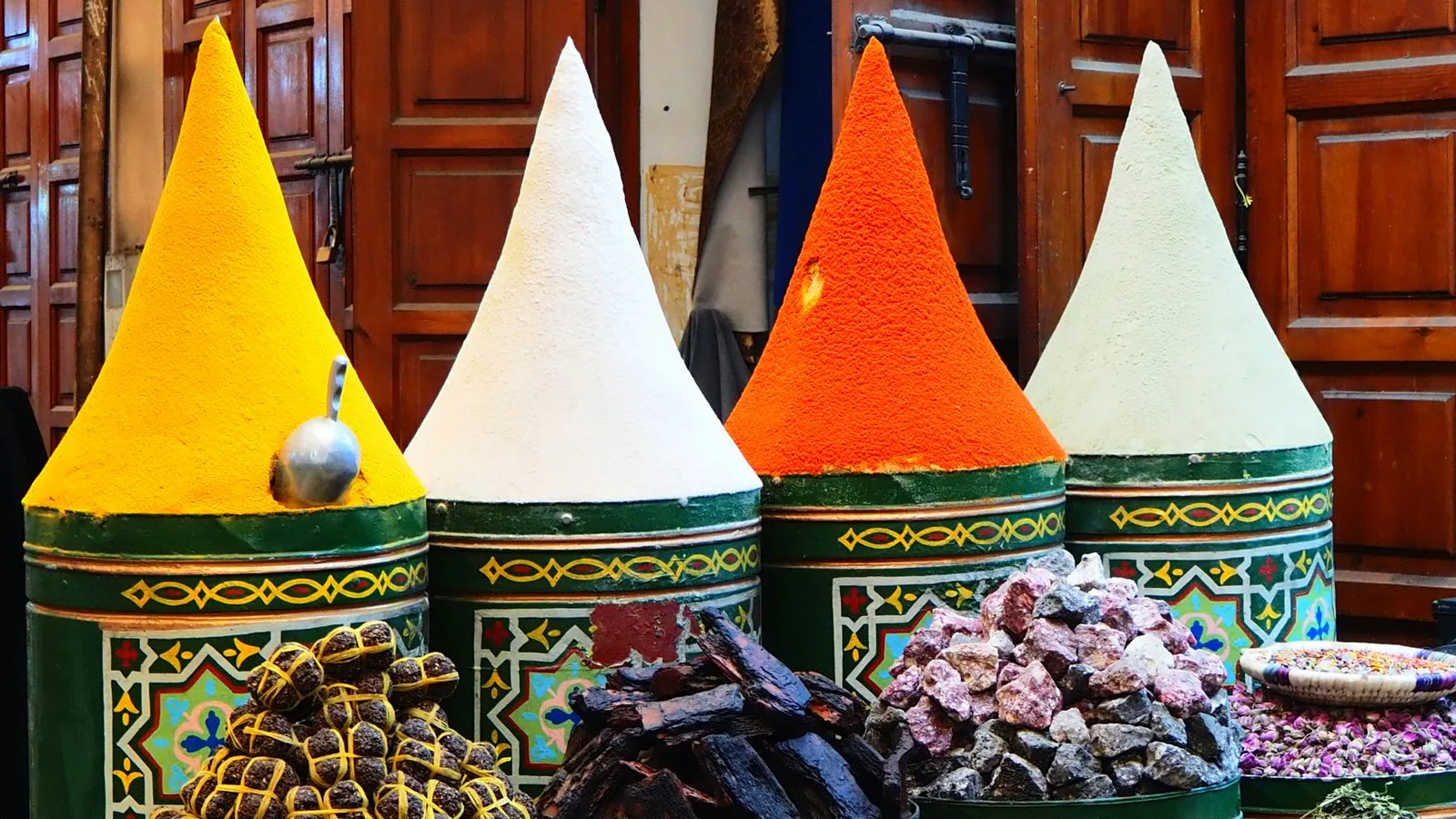
Plan to bring no dirhams in and to leave with none: change or withdraw what you need on arrival, then spend or change back the rest before you fly. The reason: Morocco's exchange office tolerates up to 2,000 dirhams (MAD) in cash, but the U.S. State Department says exporting dirhams is prohibited.
| Option | Best for | Pros | Cons |
|---|---|---|---|
| ATM withdrawal | Your day-to-day cash | Plentiful in cities and airports | Your bank's foreign fees; rare in villages and the desert |
| Card payment | Hotels, larger restaurants, chain shops | No cash to carry | Often refused in souks, small cafés and taxis |
| Exchanging cash on arrival | A backup if your card fails | Works without a bank card | Bring clean, undamaged notes; keep the receipt |
Tell your bank, then carry two cards. A card blocked on its first foreign withdrawal leaves you without cash; a second card, kept apart, solves it.
Keep your exchange slips: airport counters change leftover dirhams back, up to 2,000 per passport, with your boarding pass.
How much to tip in Morocco
Tips are part of daily life, paid in cash. Treat these as indicative ranges, as of October 2026. Some upscale places already add a service charge, so check the bill.
| Who | Usual tip |
|---|---|
| Café or casual restaurant | Round up, or about 5–10% |
| Smarter restaurant | About 10–15% |
| Public hammam | 10–20 MAD |
| Spa or palace hammam | About 50–100 MAD |
| Guide, driver, riad porter | Not in most tour prices: ask your operator or riad |
We would set aside 10-dirham coins and 20-dirham notes from day one, so a tip never means breaking a large note.
Step 8: Set up your phone
You want data the moment you land, to find your driver and your riad. An eSIM installed before you fly does that. A local SIM from Maroc Telecom, Orange or inwi is the alternative, but Moroccan rules have required a passport to register a prepaid SIM since 2014, so expect a stop at an operator shop.
Skip the eSIM if your phone is carrier-locked or not eSIM-compatible: ask your carrier. Coverage thins out in the mountains and the desert, so download offline maps before you go.
Step 9: Buy travel insurance
Insurance is not an entry requirement on the government pages we read, but your home health plan may pay little in Morocco: Medicare usually does not cover care outside the US, per Medicare.gov. What matters most is emergency medical and evacuation cover; with a desert night or a mountain road on your plan, we would not leave without it.
Some cancellation benefits depend on when you buy, so read the wording. We are not insurance brokers, and no policy suits everyone. What a Morocco policy should cover is in our guide to whether you need travel insurance for Morocco.
Compare travel insurance policies →
Step 10: Book your airport transfer
Landing at night, with luggage, for a riad cars cannot reach: that is the moment to pre-book.
For a daytime landing at a new-town hotel, a taxi is enough: Marrakech airport's official kech.cab counter posts a fixed fare. Landing in Casablanca, take the train: the airport station is about five minutes' walk from the terminal, with one train an hour from 5:30 a.m. to 11 p.m., and Marrakech from 198 MAD (ONCF, as of October 2026). The rest of the trip is covered in our guide to getting around Morocco by train, bus, taxi or car.
Book a Marrakech airport transfer for your first night →
Step 11: Book tours last, except the desert
Day trips can wait until you know your free days, often until you arrive. The exception is a multi-day desert tour in spring and fall, when well-rated tours and camps fill first: book it right after your first nights. Before you pay, check the meals, entrance fees and where it drops you: a tour ending in Fes fits a one-way route.
Compare Sahara and day tours →
Best choice by situation
These are the Morocco travel tips and recommendations that change most from one traveler to the next.
| Your situation | Best choice | Why |
|---|---|---|
| Tight budget, first trip | Simple medina riad + shared desert tour | The two biggest costs at their lowest |
| A first trip of 7 to 10 days | One-way route, desert by tour | A tour ending in Fes saves the drive back |
| Desert night or Atlas trek on the plan | Insurance with evacuation cover | Remote areas are where it matters |
What to wear and what to pack
- Clothes that follow local dress codes: the respectful choice in medinas and villages.
- Closed shoes with a good grip: medina lanes are uneven, and you walk more than you expect.
- A warm layer for a desert night: the dunes cool fast after dark, and winter nights in the camps are cold.
- A plug adapter for types C and E: Morocco runs on 230 V, so check that your chargers accept it.
Non-Muslims visit Casablanca's Hassan II Mosque on guided tours only. Ask before you photograph people.
Before you fly: the checklist
Your first Morocco trip, in order
0 / 12 doneFAQ
How far in advance should I plan a trip to Morocco?
As soon as your dates are fixed: passport first, then flights and first nights, then a desert tour in spring or fall. Day trips can wait until you arrive.
Can I take Moroccan dirhams in or out of Morocco?
Plan on neither: get dirhams on arrival and spend or change back the rest before you leave. Morocco tolerates up to 2,000 dirhams in cash, but the U.S. State Department says exporting them is prohibited.
Do I have to tip in Morocco?
Small tips are customary rather than required. Round up in cafés, leave roughly 5–10% in casual restaurants (an indicative figure), and ask your riad or tour operator what is usual for guides and drivers.